Pond fish farming is becoming more technical, but feed choices remain surprisingly inconsistent. FAO’s The State of World Fisheries and Aquaculture 2024 reported 185.4 million tonnes of global aquatic animal production in 2022. Aquaculture supplied 94.4 million tonnes, exceeding capture fisheries for the first time. This shift increases demand for stable, digestible, and easy-to-handle pond feeds. Pond fish food sticks manufacturer selection now affects more than price. It influences water clarity, feeding efficiency, fish growth, and daily labor.
Industry data also shows why buyers need stronger supplier checks. Alltech’s 2024 Agri-Food Outlook estimated global aquaculture feed production at approximately 56 million metric tonnes in 2023. However, feed volume does not guarantee consistent quality. A floating stick should remain visible long enough for fish to consume it, without quickly breaking into cloudy particles. Small details matter. Moisture control, protein sources, pellet density, packaging strength, and batch traceability deserve direct questions.
Dr. Kevin Fitzsimmons, a leading aquaculture specialist, has said, “Aquaculture is the fastest-growing food sector in the world.” His statement reflects expanding production, but growth alone is not enough. Some manufacturers still present impressive specifications without publishing practical feeding results. That is a weakness worth noticing. This guide reviews seven pond fish food sticks manufacturers for global buyers, focusing on formulation expertise, production reliability, export readiness, quality documentation, and real pond performance. The comparison is useful, though no ranking can replace a controlled feeding trial under local water conditions.
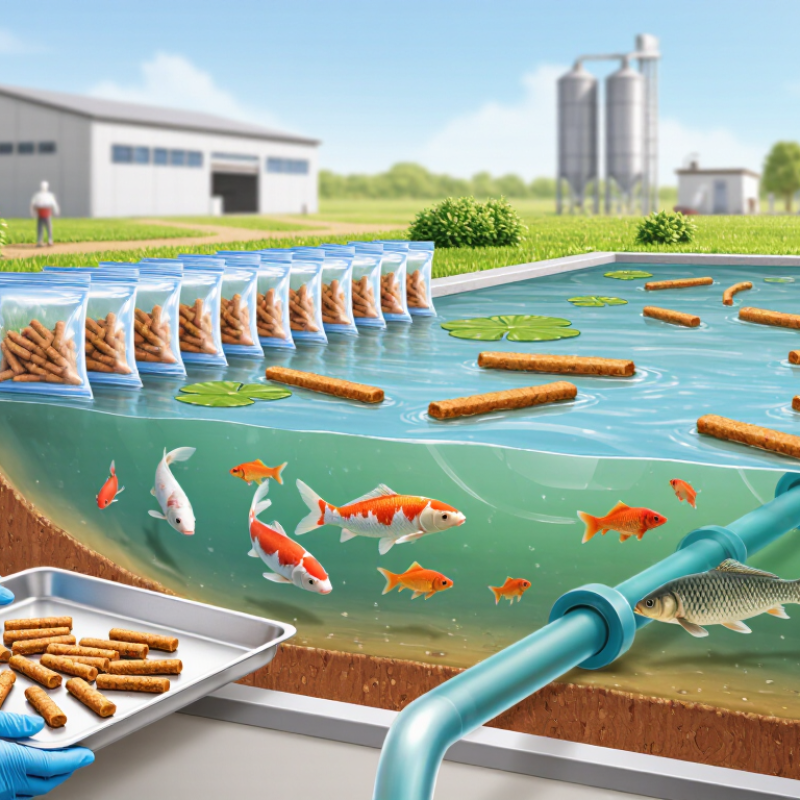
Pond fish food sticks are compact, extruded feeds designed to float or sink slowly. They usually contain fishmeal or plant proteins, oils, vitamins, and minerals. Their shape helps farmers observe feeding activity. Uneaten sticks remain visible longer. That matters in ponds with muddy water or dense vegetation.
According to the FAO State of World Fisheries and Aquaculture 2024 report, global aquaculture produced 94.4 million tonnes of aquatic animals in 2022. This scale increases demand for consistent, digestible feed. A well-made stick can support muscle growth, energy supply, and immune function when its nutrient profile matches the species. Protein quality matters more than protein percentage alone. Poorly balanced amino acids may increase waste.
Water stability is equally important. A stick that breaks apart quickly can cloud the pond and encourage ammonia problems. Feed should soften without dissolving immediately. Fish size, temperature, stocking density, and feeding frequency also affect results. No formulation works perfectly everywhere.
Global buyers should request proximate analysis, ingredient specifications, batch records, and contaminant testing. Independent testing is useful, especially for imported feed. The Global Aquaculture Alliance has repeatedly emphasized responsible feed management and traceability across aquaculture supply chains. Buyers should also check shelf life and storage instructions. Heat and humidity can damage oils before the stated expiry date. One practical weakness remains: many feeding decisions rely on habit, not observation. Watching appetite and checking pond water can reveal more than a product label.
Key Criteria for Evaluating Pond Fish Food Stick Manufacturers
A reliable manufacturer should show clear control over ingredients, production, and testing. Ask for complete ingredient specifications, including protein sources, oils, binders, vitamins, and mineral levels. Traceable suppliers matter because inconsistent raw materials can change growth results. In practical sourcing, I have found that a polished website proves very little. Request recent laboratory reports for moisture, protein, fat, microbial safety, and heavy-metal limits. Samples matter. Test the sticks in real pond conditions. Observe whether they float evenly, soften within a useful period, and leave excessive dust or cloudy water.
Manufacturing experience should also appear in documented quality procedures, not only sales claims. Check batch records, production capacity, storage conditions, packaging strength, and export experience. A dependable supplier should explain minimum order quantities, lead times, shelf life, and transport protection without vague answers. Ask whether formulas can suit carp, koi, tilapia, or mixed pond populations. Feeding behavior may change with water temperature, fish size, and stocking density. Details reveal more. Independent certification can support credibility, but buyers should verify its scope and validity. I would also compare several batches, because one successful sample may hide seasonal variation. No evaluation is perfect; even experienced buyers can overlook how humidity affects unopened packaging during long-distance shipping.
| No. | Evaluation Dimension | What to Assess | Useful Benchmark or Specification | Documents or Evidence to Request | Buyer Relevance |
|---|---|---|---|---|---|
| 1 | Nutritional Formulation | Check whether the formula is designed for the target pond species, life stage, water temperature, and feeding purpose. | Species-specific formulation; protein, fat, fiber, ash, moisture, vitamins, and minerals should be clearly declared rather than described only as “complete nutrition.” | Guaranteed analysis, ingredient list, feeding guide, formulation sheet, and laboratory test results. | Helps buyers match the product with koi, goldfish, ornamental carp, or other pond fish without relying on generic claims. |
| 2 | Stick Buoyancy and Water Stability | Evaluate whether sticks float visibly, remain intact long enough for observation, and avoid excessive clouding or rapid disintegration. | Stable floating performance during the recommended feeding period, with low dust and limited surface residue under normal use. | Sample-test results, product specification, feeding videos under controlled conditions, and a physical sample from the production lot. | Floating food improves feeding visibility and can reduce uneaten food remaining on the pond bottom. |
| 3 | Ingredient Quality and Traceability | Review the origin, consistency, and traceability of fish meal, plant proteins, oils, binders, pigments, and functional additives. | Lot-level traceability from incoming raw materials through blending, extrusion or forming, drying, and packing. | Supplier approval records, raw-material specifications, certificates of analysis, allergen statements, and traceability procedure. | Supports consistent quality and makes recalls or complaint investigations more manageable. |
| 4 | Food Safety and Quality Control | Assess controls for microbiological contamination, moisture, oxidation, foreign matter, heavy metals, and prohibited substances. | A documented HACCP-based food-safety system or an equivalent preventive-control program, supported by routine testing. | HACCP plan, ISO 22000 or equivalent certification where applicable, recent test reports, sanitation records, and recall procedure. | Reduces regulatory, reputational, and product-safety risks in international distribution. |
| 5 | Manufacturing Capacity and Batch Consistency | Verify whether the supplier can maintain the same size, density, color, odor, packaging, and nutritional profile across repeat orders. | Defined batch-release specifications covering dimensions, moisture, appearance, net weight, and laboratory parameters. | Factory profile, production-flow description, quality-control plan, batch records, capacity statement, and retention-sample policy. | Important for importers, distributors, and retailers that need reliable replenishment and consistent shelf presentation. |
| 6 | Packaging, Shelf Life, and Logistics | Review protection against moisture, oxygen, light, crushing, and temperature fluctuations during storage and transport. | Clearly stated shelf life and storage conditions, with packaging suitable for the intended climate and shipping route. | Packaging material specification, shelf-life study or stability data, carton dimensions, pallet information, and loading photos. | Good packaging helps preserve texture, buoyancy, freshness, and saleable condition during global transport. |
| 7 | Export Compliance and Customization | Check capability for destination-market labeling, language requirements, private-label packaging, minimum order quantities, and documentation. | Written compliance support for the target market, including ingredient labeling, net quantity, batch identification, production date, expiry date, and storage instructions. | Sample labels, export documents, product registration guidance, HS-code support, packaging artwork process, MOQ, and lead-time schedule. | Determines whether the supplier can support a legally compliant and commercially viable international launch. |
Seven leading pond fish food stick manufacturers serve global buyers with different production strengths. The first focuses on floating sticks that remain visible for several minutes, helping farmers monitor feeding. Another specializes in high-protein formulas for koi and other ornamental fish. Its technical team should provide ingredient specifications and feeding guidance, not vague promises.
A third manufacturer offers low-temperature processing to protect sensitive nutrients. A fourth supports private-label orders with flexible packaging sizes, from small retail bags to bulk cartons. The fifth emphasizes water stability, which can reduce cloudy water and uneaten residue. A sixth develops region-specific formulas for warm climates, where fish metabolism and storage conditions may change quickly. The seventh combines automated production with laboratory checks for moisture, protein, buoyancy, and microbial safety.
Details matter. A reliable supplier should share batch numbers, production dates, certificates, and traceable raw-material records.
Ask for samples before signing a large contract. Watch how the sticks behave after ten minutes in a clean tank. They should soften gradually, not disappear into dust.
No manufacturer is flawless. Packaging can fail in humid ports, and a formula that performs well in one pond may disappoint in another. Buyers should review trial results, transport conditions, and local feeding habits instead of trusting attractive claims alone. Clear communication often reveals more than polished catalogs.
Choosing among seven pond fish food stick manufacturers requires more than checking the lowest quotation. Experienced buyers should examine protein levels, pellet density, water stability, and ingredient consistency. A suitable stick should soften gradually, not dissolve into cloudy water within minutes. Poor water stability can increase waste and complicate pond maintenance.
Product testing matters. Ask for recent laboratory reports, batch specifications, moisture data, and feeding recommendations. Packaging also deserves close attention. A strong inner liner, sealed outer bag, and moisture-resistant carton can protect feed during humid sea transport. Smaller retail packs improve handling, while bulk sacks may reduce unit costs. However, cheaper packaging is not always economical.
Pricing should include product value, minimum order quantity, tooling, inland delivery, and export charges. Some manufacturers offer attractive factory prices but provide limited documentation or slow replies. Reliable export service includes clear invoices, packing lists, certificates, loading photos, and practical shipping coordination. Confirm carton dimensions and pallet patterns before production starts. Small errors create expensive delays.
A sample order is wise. Compare stick length, smell, color, floating time, and residue after soaking. I have found that visual quality can mislead. One sample may perform well, while later batches vary slightly. That weakness deserves discussion, not concealment. Buyers should record inspection results and agree on acceptable limits before signing a purchase contract. Clear communication often matters as much as the feed itself.
7 Best Pond Fish Food Sticks Manufacturers for Global Buyers
Global buyers should assess more than price when comparing pond fish food stick manufacturers. MOQ often reveals production flexibility. A low MOQ helps with market testing, while a high MOQ may reduce unit costs but increase storage pressure. Request a written sample policy, batch size, shelf life, and packaging options before placing an order. Small details matter.
Certifications must match the destination market and product category. Ask for current factory certificates, ingredient traceability, laboratory reports, and contaminant testing. Feed safety systems, hygienic production controls, and clear allergen statements support responsible purchasing. Do not accept certificates with unclear scopes or expired dates. I have seen buyers overlook this point.
Shipping performance also affects product quality. Confirm lead time, carton dimensions, pallet details, moisture protection, and agreed Incoterms. Fish food sticks can soften when exposed to humidity, so inner liners and sealed cartons deserve attention. Request customs documents before dispatch. Delays happen. Build a buffer.
Reliable support should include formulation guidance, artwork checks, complaint handling, and production updates. A capable manufacturer can explain sinking speed, water stability, protein levels, and feeding suitability for different pond species. Communication should remain clear after payment. That is where weak suppliers often become difficult. My own purchasing reviews sometimes focused too heavily on quotations, not response quality. That mistake can be expensive.
This 100-point planning model highlights the purchasing factors global buyers commonly review: certifications and shipping receive the highest weighting, followed by minimum order quantity, product quality, and supplier support. The scorecard is a general procurement framework and does not represent any specific company or brand.
They are compact feeds designed to float or sink slowly. Their shape helps farmers watch fish feeding. Uneaten pieces remain visible in muddy water.
Balanced protein supports muscle growth and tissue repair. Oils provide energy, while vitamins and minerals support normal body functions. Protein quality matters more than the percentage alone.
A stable stick softens gradually instead of dissolving immediately. Fast breakdown can cloud the pond and increase waste. Cleaner water helps reduce maintenance problems.
Fish size, water temperature, stocking density, and feeding frequency all matter. A formula may work well in one pond but poorly elsewhere. No formulation fits every situation.
Request ingredient specifications, laboratory reports, batch records, shelf-life details, and storage instructions. Testing should cover moisture, protein, fat, microbes, and heavy metals. Paperwork is not proof by itself.
Test samples in real pond conditions when possible. Observe floating time, softening speed, smell, color, dust, and residue. Watch appetite, not only appearance.
Moisture-resistant cartons and sealed inner bags help protect feed during humid transport. Confirm carton dimensions and pallet patterns before production. Small packing errors can cause costly delays.
Not always. Compare feed quality, packaging, minimum order quantities, testing, delivery, and export charges. A cheap quotation may hide weak documentation or slow communication.
One sample can mislead. Later batches may vary slightly because raw materials or humidity change. Compare several batches and agree on acceptable limits before purchasing. Even careful buyers overlook things.
Pond fish food sticks are a practical feeding option for ornamental and farmed pond fish, offering balanced nutrition in a convenient floating or slow-sinking form. A well-formulated product can support healthy growth, vibrant coloration, digestion, and water quality when used according to fish species, size, and feeding conditions. This guide explains how to assess a Pond fish food sticks manufacturer by examining ingredient quality, nutritional consistency, production controls, product customization, and reliability.
It also presents seven types of leading manufacturers suitable for global buyers and compares their product quality, pricing, packaging choices, and export capabilities. Key purchasing considerations include minimum order quantities, certification availability, shelf life, labeling requirements, shipping arrangements, documentation, and after-sales support. By reviewing these factors together, importers, distributors, retailers, and aquaculture businesses can select a dependable supplier that provides safe, consistent pond fish food sticks and supports efficient international procurement.